Guides
Commercial Locksmith Service Call Checklist for Property Managers
A commercial locksmith service call checklist property managers can use: the call sequence, first-month, seasonal and yearly checks, and warning signs to watch.
What to take away
- Group locksmith work by interval, not by door hardware. Monthly checks catch the small failures; annual checks catch the code and key-control problems.
- The first thing to fail from neglect is the door closer, followed by the cylinder. Both show up as sticking before they show up as a lockout.
- Every call should end with a signed work order naming the door, the part, and the next inspection date. That record is what protects you at renewal.
- Storefront rekey requests in New York City and Atlanta follow different rules. New York City rekeys can touch egress hardware the building and fire codes control; Atlanta rekeys are usually a cylinder swap on a narrow-stile glass door.
A commercial building does not fail all at once. It fails door by door, usually on the door nobody walks through until a tenant moves in. A checklist built around intervals keeps the quiet doors in view.
Before the locksmith arrives
The interval checks below say what to inspect. A single call runs in this order, and the property manager owns every step except the wrench work.
- Before you call.Pull the door's record: location, keyway, hardware, whether the door sits on a required exit, and the name of the person authorized to approve the work. Keep the vendor's license number and certificate of insurance on file before dispatch, not after.
- Scheduling.Ask for the arrival window, the trip charge, the after-hours rate, and any parts markup in writing before you approve the dispatch. An emergency call costs more because of the hour, not because the repair is different.
- Arrival.Confirm the technician and the company name on arrival, walk the door together, and make the technician name the failed part and the proposed fix before any work starts.
- Authorization.Only the named approver signs off on work beyond the agreed scope. A technician who cannot reach that person stops and reschedules.
- Completion.Test the door closed and latched, including the exit device and the closer, before the technician leaves. Get the signed work order naming the door, the part, and the next inspection date, and match the invoice to the contracted rate before it is paid.
- Verification.Check the license number against the issuing body's lookup — New York City licenses locksmiths through the Department of Consumer and Worker Protection — keep a current certificate of insurance that names the building, and hold a workers' compensation certificate. A state or city bond, where one is required, goes in the same file.
After the first month
Run this list once the vendor has completed the initial survey and any opening work.
- Confirm every exterior door in the keying schedule matches the actual cylinder.
- Test each panic bar and exit device with the door closed, not propped.
- Walk the master key against every tenant suite door.
- Photograph each cylinder and record its keyway.
- File the vendor's work order against the building record.
If the vendor cannot produce a keying schedule, that is the finding. A schedule is the document that tells the next locksmith what already exists.
Each season
Seasonal checks are about weather and occupancy. In cold markets, exterior cylinders stiffen and closer arms loosen. In hot markets, door frames move and strike plates drift.
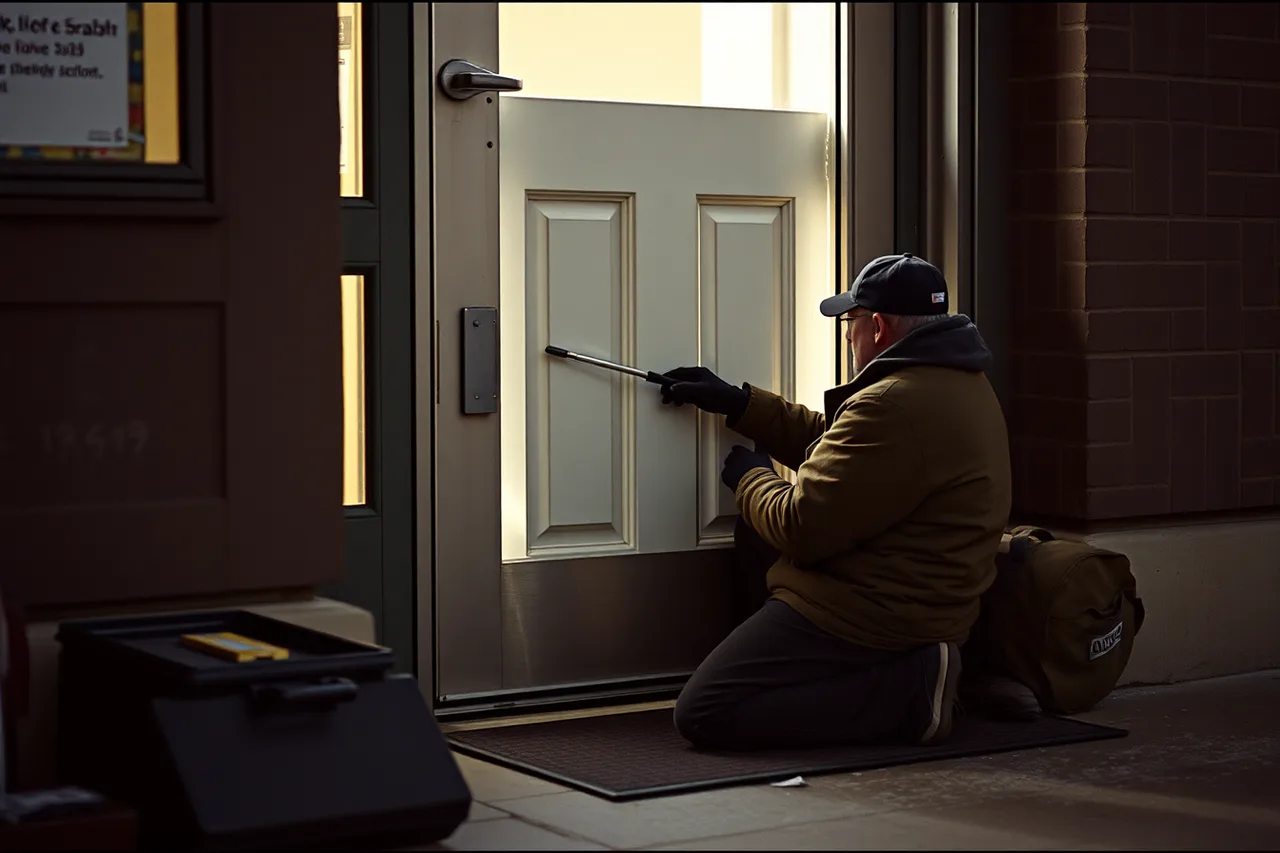
A door that sticks in October is a door that will not latch in January. Fix the strike plate before the first freeze.
Re-key requests cluster around tenant turnover. In Atlanta, a storefront rekey is often a cylinder swap on a glass door with a narrow stile.
In New York City, the same request can touch egress hardware. The New York City Building Code and the New York City Fire Code control what a locksmith may change on a door, and the Department of Buildings and the Fire Department of New York enforce them. A required exit must stay openable from the inside without a key, and hardware on a fire-rated door may only be replaced with listed components.
Once a year
Annual work is where code compliance lives. Two NFPA documents decide most of it: NFPA 101, the Life Safety Code, for egress, and NFPA 80 for fire doors and other opening protectives. Those rules decide whether a lock can stay on a door at all, and they are why a rated door cannot be drilled, wedged, or fitted with unlisted hardware. Check the current editions at the NFPA codes and standards page before approving any change to an exit door.
Annual tasks:
- Audit the master key system and revoke lost keys.
- Inspect every exit device for free egress with the door latched, against NFPA 101, the Life Safety Code.
- Confirm every fire-rated door still carries its label and listed hardware, as NFPA 80 requires.
- Test electronic access credentials and battery backup.
- Review the vendor's invoice against the contracted rate.
- Update the door inventory with any new tenant buildouts.
Electronic access adds a second audit. Networked readers need firmware and credential review, and the IEEE standards portal is where the underlying networking standards are published. A property manager who tracks that work separately from mechanical locks avoids surprise failures.
Every few years
Some work is not annual. Cylinders wear out. Closers reach the end of their adjustment range. Older mechanical push-button locks lose their reliability and become a liability on a fire door.
Plan a full cylinder replacement cycle by use, not calendar alone. A loading dock door may need it in three years. A quiet stairwell door may last fifteen.
The maintenance and operations framework behind this planning is in the Wikipedia entry on maintenance, repair, and operations. It treats replacement cycles as a scheduling problem, not a repair problem.
This is also the interval for renegotiating the recurring contract. A vendor who has held the account for several years should be able to show a service history. The service quality review method describes what a defensible history looks like from the vendor's side.
Signs it needs attention now
| Symptom | Likely cause | Action |
|---|---|---|
| Key turns hard in one door only | Worn cylinder or misaligned strike | Rekey or adjust within the week |
| Door does not latch when pulled shut | Closer arm or strike plate drift | Adjust before the next weekend |
| Panic bar needs two pushes | Linkage wear or frame rub | Same-day service, egress issue |
| Key breaks inside the cylinder | Cheap blank or worn pins | Extract and replace cylinder |
| Reader rejects valid credentials | Battery or firmware fault | Test backup key path today |